STEP BY STEP
How to Use a Bitcoin ATM, and Every Trap Along the Way
This teaches the process honestly, because some people are going to use one regardless and doing it wrong is worse than doing it well. But every step comes with what can go wrong at that step — especially the two actions you cannot take back.
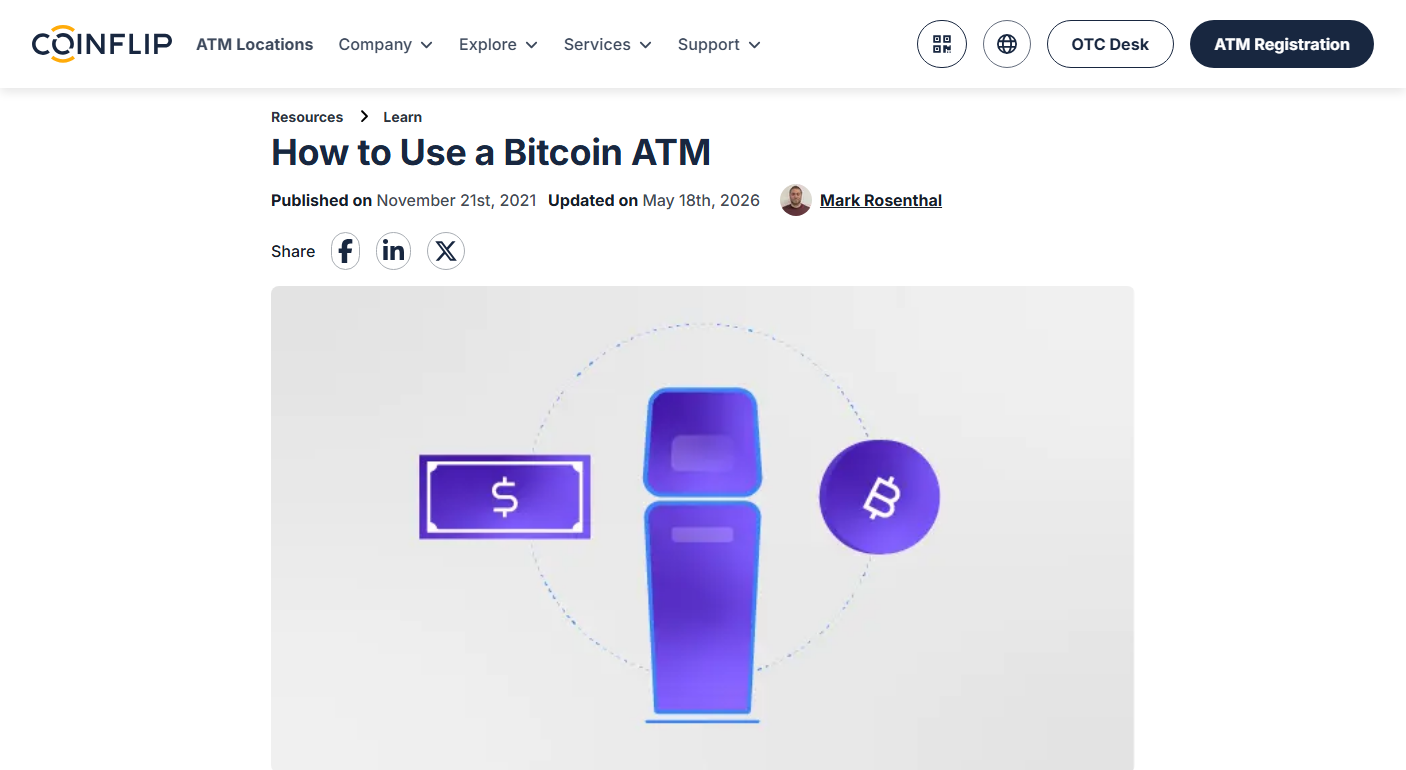
The machine near the side entrance usually has nobody standing at it. The screen glows, generally with BUY BITCOIN across the top, a note slot that looks like a supermarket till, and sometimes a small card reader. Most people seeing one for the first time think: this is basically an ATM. Put money in, press a few buttons, done.
Mechanically, close enough. The problem is that when something goes wrong at a bank ATM you ring the bank and they freeze it, reverse it, chase it. At this machine there are two actions that, once done, nobody can undo. This walks through the whole thing, and marks those two clearly.
What the machine actually does
A bitcoin ATM is not a cash machine. It is an automated over-the-counter desk: you feed in notes, and the operator sends bitcoin from its own holdings to a wallet address you supply, at a price it sets.
Three phrases in there, three traps.
"The operator." The machine doesn't belong to bitcoin, and it doesn't belong to an exchange. It belongs to a company that bought the hardware, rents that patch of floor, and pays someone to come and empty the cash box. Every rule you meet at that machine — the fee, the limits, what ID it wants — is that company's, not an industry standard. Different machine, potentially very different rules.
"At a price it sets." The rate on screen is not the market rate. The operator builds its own margin into that number, and that margin is not shown separately. We wrote a whole piece on this, because it is where most people lose the most money without noticing.
"To a wallet address you supply." The coins aren't stored in the machine or in an account. The machine broadcasts a real bitcoin transaction to whatever address appears on that screen. It behaves like any other bitcoin transaction: irreversible, unmodifiable, and no support desk anywhere can pull it back.
Two kinds of machine
One-way machines only take cash and send coins. Two-way machines also buy coins back and pay out cash. One-way is the large majority.
Work out which one you're heading to before you go, because turning up to the wrong kind is a wasted trip.
One-way (cash-in)
Takes notes, sends coins, that's it. Most machines in shops, servos and laundromats are these. They're usually physically smaller and — the quickest tell — have no cash dispenser slot. No slot means it cannot pay you out.
Two-way (cash-in and cash-out)
Buys and sells. Selling runs in reverse: you create an order, the machine gives you an address, you send coins from your wallet, you wait for confirmations, and only then does it hand over notes. The wait is longer than buying and the fee structure is different. There's a separate piece on the sell side.
The rules every Australian machine works under
Since mid-2025, crypto ATM operators in Australia have operated under sector-wide conditions from the financial intelligence regulator: a hard AU$5,000 cap on cash in or out per transaction, mandatory scam warnings on the machine, stronger identity checks, and closer transaction monitoring.
These are worth knowing about before you arrive, for two reasons.
The first is practical: the AU$5,000 cap applies regardless of what tier you've verified to. If you were planning a larger purchase in one go, it isn't going to happen at a machine here. The limits piece covers how this stacks with operator limits.
The second matters more. Those rules exist because of what the regulator found in high-volume activity. In a sample of the ninety most prolific users nationally, AUSTRAC and law-enforcement partners estimated that 85% of transactions were proceeds of scams or money-mule activity. People aged 50 to 70 accounted for close to 72% of transaction value in separate taskforce data.
That is not a statistic about a fringe problem. That is most of the volume.
So when the machine shows you a scam warning before you pay, that warning is not boilerplate. It is there because a very large share of the people standing where you are standing were being defrauded. If anything about how you got here came from someone else, read the three questions before you go further.
Enforcement is real, too. In August 2026 the regulator suspended one operator's registration for three months, which took all 96 of that company's machines offline nationally. So it is also worth checking a machine is still live before driving to it.
The one thing to do before you leave home
Have a bitcoin wallet, and know how to bring up its receiving QR code. Turning up without one is the classic beginner mistake.
The word wallet misleads people. It doesn't hold coins — those live on the blockchain. It holds the keys that control them. For this job it needs to do exactly one thing: give you a receiving address and a QR code for the machine to scan.
Getting ready
- Install a bitcoin wallet app on your phone and let it create a new wallet. It will show you a recovery phrase, usually 12 or 24 English words.
- Write the recovery phrase on paper and put it somewhere safe. Don't screenshot it, don't put it in your photos, don't message it to yourself. Anyone with those words can move your coins — no password needed, no access to your phone needed.
- Open Receive in the wallet. You'll see a string starting bc1, 1 or 3, plus a QR code. That's what gets scanned.
- Bring the QR code up once before leaving and turn your screen brightness right up. Machine cameras struggle with dim screens more than anything else.
The trap at this step
Some machines offer an "I don't have a wallet" option and print you a paper wallet with the private key on the receipt. It looks helpful. It is genuinely risky: that slip of paper is the money, and if it's photographed, copied, soaked, or thrown out, the coins are gone with no recourse. Unless you know exactly what you're doing, go home and set up a wallet first.
Seven steps at the machine
Wording differs between operators, order rarely does.
1. Choose buy
The home screen normally offers Buy and Sell; one-way machines only offer Buy. Some ask which coin first — plenty support more than bitcoin, so read it. There's often a language selection after that.
2. Identity check
How much you have to prove scales with the amount. Small amounts often need only a mobile number and an SMS code. Higher amounts want a scanned ID document, a photo of your face, sometimes both together. Australian operators have tightened this since the 2025 rule changes. More detail here.
3. Give it your wallet address
The camera opens and you hold up your receiving QR code. Once scanned, the address appears on screen.
Stop here and check it. Not the whole string — just the first four or five characters and the last four or five, against your wallet. That second is the highest-value second in the entire process.
IRREVERSIBLE ACTION — ONE OF TWO
Once you confirm the address, it's fixed. Coins go to whatever address you confirmed, whether or not it's yours. If that address came from someone else — a message, a photo, someone reading it out to you — this is your last chance to stop.
4. Feed in the cash
The slot takes anywhere from a few notes to a stack, and the running total appears as it goes. Notes get rejected fairly often — old, creased, marked. Flatten a rejected note and try again and it usually goes.
IRREVERSIBLE ACTION — TWO OF TWO
Cash that goes in does not come back out. Almost no machine has a cancel-and-refund function. You either finish the transaction or you're left with an unresolved order and a support line to call. Get everything checked before the notes go in.
5. Read the quote properly
After the cash, you get a summary: amount in, coins out, fee.
Look twice at this. The fee line is what the operator is disclosing, but the coins-out figure carries the rate they're giving you. Divide the cash by the coins and you have the actual price per bitcoin this machine is charging — compare it to the market price and the gap is the part that wasn't on screen.
Your phone is in your hand. It takes thirty seconds, and we built a spread checker for exactly this.
6. Confirm
The machine broadcasts the transaction. You'll usually get a transaction ID — a long hexadecimal string, sometimes called a txid — displayed or offered as a QR code.
7. Take the receipt
It prints one: order number, address, amount, rate, operator contact, often the transaction ID.
Keep it, and photograph it now. Thermal paper fades to blank in a few months. That slip is the only physical proof you'll have — here's which lines matter.
What the words on the screen mean
| On screen | Means | Watch for |
|---|---|---|
| Buy / Sell | Direction | One-way machines only show Buy |
| Wallet Address | Where coins go | Cannot be changed after confirming |
| Insert Cash / Bills | Feed notes in | No way to get them back out |
| Exchange Rate | This machine's price | Not the market price — margin lives here |
| Fee / Commission | Operator's disclosed charge | Only the first layer |
| Network / Miner Fee | Paid to the bitcoin network | Fixed amount, nothing to do with the operator |
| Transaction ID / TXID | On-chain reference | Use it to track your own transaction |
| Confirmations | Blocks stacked on top | Determines when you can spend |
| Tier / Limit | Verification level and cap | Sits under the AU$5,000 ceiling |
The line worth an extra look is Exchange Rate. Many people read it as the current bitcoin price. It's the price this machine will sell at. That gap, plus the fee line, is your real cost.
How much cash to bring, and no change
Machines take notes only, no coins, and they do not give change. Whatever goes in is what you're spending.
This is the bit that catches people. A bank ATM gives you what you ask for. This works the opposite way — everything you feed in gets converted. There is no "put in a bit and see" option, because whatever you put in is committed.
So bring exactly what you intend to spend, and nothing more. It sounds crude. It is the single most effective thing you can do to protect yourself, and it also stops you talking yourself into a larger purchase while standing there.
On note denominations: mid-size notes feed fastest. All-large can hit per-note limits on some machines; all-small takes ages to feed and jams more, and the longer you stand at that machine the worse.
Those ten minutes, and what's around you
Most guides skip this. You are about to stand at a machine, holding cash, staring at a screen, for five to ten minutes. That picture is worth thinking about.
- Not late at night at an isolated machine. Plenty operate inside venues open until very late. At that hour, in that spot, you are the only person there holding cash.
- Don't count money in the open. Separate what you need into a pocket beforehand and feed it straight in.
- Be wary of anyone who happens to be helping. A stranger who talks you through which option to pick is a problem, however friendly. You do not need anyone's help with this.
- Leave when you're done. Don't hang around waiting for confirmation — that takes block time and standing there achieves nothing.
And the different case entirely: if you're at this machine because someone on the phone told you to be, none of the above is the issue. No government agency, police force, court, tax office, utility, delivery company or legitimate business will ever ask you to pay through a bitcoin ATM. What you need is the three questions, not better technique.
Every trap, in one table
| Step | What goes wrong | Fixable? |
|---|---|---|
| Wallet setup | Using a printed paper wallet, key exposed on paper | Yes, if moved quickly |
| ID check | Tier too low for the amount | Yes, verify up or reduce |
| Address | Wrong address, or one supplied by someone else | No |
| Cash in | Change of mind mid-way, notes not returnable | Essentially no |
| Quote | Spread missed, real cost far above the fee shown | No, once confirmed |
| Confirm | Transaction broadcast | No |
| Receipt | Left behind or lost, no proof afterwards | Hard, unless the operator has records |
The four red rows share something: they all happen within a few seconds of each other, and none can be walked back. Which is exactly why this article keeps putting "stop and check" before them. All of your safety margin sits before the confirm button.
After you press confirm
The coins don't appear immediately. The machine has broadcast an ordinary bitcoin transaction, and the network has to include it in a block before your wallet shows anything.
Bitcoin produces a block roughly every ten minutes on average, so a wait of anywhere from a quarter of an hour to an hour is normal. Some wallets display a balance after one confirmation, others hold off for more.
"The machine said complete but my phone shows nothing" is therefore the expected experience, not a failure. When you should actually start worrying, and how to look up your own transaction on a public block explorer using the ID from the receipt, is in the piece on waiting. You can check it yourself at mempool.space without contacting anybody.
When it goes wrong
Notes keep coming back
Worn, folded, marked or written-on notes get rejected by the validator. Flatten and retry. If the whole stack refuses, the validator is probably dirty or the cash box is full — try a different machine.
The QR code won't scan
Screen brightness first, privacy screen protector second. Most machines allow manual entry of the address as a fallback, but the string is long and typing it is error-prone — check it in segments if you do.
Stuck on processing
Cash taken, spinner going, no transaction ID. Call the operator; the number is on the receipt or the machine. Have the order number, time and machine location ready.
Over the limit
The machine warns you during cash entry. What happens to the excess varies by operator — some return the notes, some hold them against an order you then have to chase. Another reason to bring only what you plan to spend.
So should you use one
Writing the process out in detail isn't a recommendation. Reading it back, you can probably feel the pattern: nearly every step shifts risk onto you, and the price isn't small.
There are situations where it's the right call — cash only, no usable bank account, a genuine need for coins on-chain today. That list is short. For most other situations the same money buys noticeably more bitcoin somewhere else, and the calculator will show you how much.
Common questions
Do I need a bank card to use a bitcoin ATM?
No. Buying takes cash, and no bank card or bank account is involved at any point. What you need is cash, a mobile number for verification, and a bitcoin wallet address. Higher amounts require a scanned identity document, but that still isn't a bank card.
Can I use a bitcoin ATM without a wallet?
Technically yes — many machines will print a paper wallet with the private key on the receipt. It is a risky option, because that piece of paper is the money and there is no recovery if it is photographed, copied or lost. Setting up a wallet app on your phone before you go is much safer.
Can I cancel and get my cash back from a bitcoin ATM?
Essentially no. The vast majority of machines have no cancel-and-refund function once notes are inside. You either complete the transaction or you are left with an unresolved order to take up with the operator's support line. All checking has to happen before the cash goes in.
Is there a limit on bitcoin ATM transactions in Australia?
Yes. Since mid-2025 a sector-wide cap of AU$5,000 applies to cash deposits and withdrawals per transaction at crypto ATMs in Australia, alongside mandatory scam warnings and stronger identity checks. Individual operators may set lower limits on top of that, tied to your verification tier.
I entered the wrong wallet address — can the coins be recovered?
No. A confirmed bitcoin transaction cannot be reversed by anyone, including the operator. This is why checking the first and last few characters of the address against your own wallet, before confirming, is the single most valuable few seconds in the whole process.
Fees, limits and identity requirements vary by operator and change over time. Australian machines have operated under sector-wide conditions imposed by the financial intelligence regulator since mid-2025, but individual operators set their own rules on top of those. Whatever the screen in front of you says is what applies.