AFTER YOU PAID
Scammed at a Bitcoin ATM: What to Do, in Order, After You've Paid
The cash is in the machine, the code has been scanned, and only now has it dawned on you that the voice on the phone was a scammer. This page puts the next steps in order: call the machine's operator and find out where the transaction stands, gather the evidence and report it, then shut the door on anyone offering to "get your money back".
Stop paying, then contact the ATM operator straight away: tell them the transaction was a scam and ask them to hold it, reverse it or refund it. Don't put that call off to go digging through the blockchain first.
A confirmed bitcoin transaction can't be cancelled the way a card payment can. That still leaves you able to report it and to ask for a refund. Whether any money comes back depends on how far the transaction got, what the operator does, and what any investigation turns up. Nobody can promise you the outcome.
If the scammer is still on the line, hang up now. The next thing you're likely to hear is "that one didn't go through, you'll need to deposit again", or "one more payment and the funds will be released". Whatever the reason given, not another dollar goes into that machine.
Finding out where the transaction stands
While you get the operator on the phone, dig out the receipt the machine printed. No receipt? Look for a text or email from the operator. Then tell two numbers apart: the operator's own order number, and the on-chain TXID (transaction hash). A field labelled "Transaction ID" may well be the internal reference. If you can't see a clear on-chain hash, ask the operator for it — and don't conclude the coins were never sent just because an order number turns up nothing.
Once you're sure the purchase was BTC on the main bitcoin network, paste the TXID into a public bitcoin block explorer such as mempool.space. Other coins and networks need their own explorer. Roughly, here's what the result tells you:
- Nothing found. The transaction may not have been broadcast yet — or the number, the network or the explorer's sync may be off. Ask the operator whether the coins have actually gone out. If they haven't, ask them to hold it immediately.
- Found, but unconfirmed. It's been broadcast but isn't in a block yet. That alone doesn't settle whether it can be stopped: some unconfirmed transactions can be replaced by whoever sent them, and whether that applies here, and whether the operator is willing, is a question only the operator can answer. Holding the receipt gives you no way to pull it back yourself. Screenshot the status and the receiving address.
- Found, with confirmations. The coins are sitting at the other side's address. Carry on through the steps below; the aim shifts from stopping it to documenting, reporting and limiting the damage.
For what each line on the receipt means and how confirmations work, the labelled receipt diagram and "it says complete but nothing arrived" go into more detail.
Technical background: Bitcoin Core's FAQ on replacing unconfirmed transactions (checked October 2026). It describes what the protocol allows, which is a different thing from a refund service any ATM operator has signed up to.
What to say when you call the operator
The US Federal Trade Commission's page on what to do if you were scammed is blunt about crypto payments: contact the exchange or ATM operator you used straight away, tell them it was a fraudulent transaction, and ask them to reverse it and give you a refund.
Work out the operator's brand from the receipt and the machine's own screens, then find a support number on the operator's website, looked up independently. Stickers on the cabinet can be covered over, so a sticker alone is a poor reason to dial a number. Never use a number the scammer gave you, and don't click a search ad promising "ATM support" either — the tricks involved are covered in can a bitcoin ATM itself be fake.
On the phone or by email, a tight set of facts gets further than the whole story:
Before you hang up, ask for a ticket or case number, and note who you spoke to and when. Police may later ask whether you told the operator; that number is your proof.
Keep expectations realistic. If the coins are already confirmed, the operator can mostly record the complaint and assist an investigation. In the US, the same FTC page notes that crypto payments lack the legal protections of credit and debit cards, but that some states have passed laws that might help you, and it points readers to the National Conference of State Legislatures (NCSL) to check their own state.
What to photograph and save today
ATM receipts are thermal paper, and the print fades. Photograph yours now. Keep two copies of everything below, backed up somewhere secure that you control, and don't post complete copies anywhere public if they show ID or account details.
| Item | Where to find it | What it shows |
|---|---|---|
| Receipt, front and back | The slip the machine printed, or the operator's text or email | Transaction number, amount, time, receiving address |
| Machine location and ID | Cabinet sticker, the shop's name and street address | Lets the operator find the machine and the record in its system |
| The QR code or address you were sent | Texts, chat apps, screenshots | Where the money went — the starting point for any trace |
| Call log | Your phone's recent calls, with numbers and times | Who was directing you, and when |
| Full chat and text history | Complete screenshots, not a few cropped lines | Who they pretended to be and what they told you |
| Bank withdrawal or transfer records | Online banking statement, withdrawal slips | Where the cash came from, matching the amount |
| The block explorer page | The result from the step above | Broadcast or confirmation status at the time you checked; unconfirmed means not yet in a block |
Block the contact if you like, but keep the conversation. If you installed remote-access software at their request, take that device off the internet and end the remote session first, then use a different, trusted device to call your bank and the operator. Don't leave them in control just to grab screenshots. After that, remove the remote-access app, run a security scan, and from a trusted device change any password that was exposed or reused and switch on two-factor authentication. For technical help, go to the device maker or someone you know and trust.
Where to report a bitcoin ATM scam (Australia, US, Canada)
Start with your local police and get a report reference number. Then file with the national body where you live. These bodies won't chase the money for you, but the reports they pool can connect the same crew across many separate cases.
The official reporting pages for the three countries below were checked in October 2026. Go to the forms from these official pages, never through a "we'll file it for you" link from a stranger.
- Australia: report to police through ReportCyber on cyber.gov.au, then use the Scamwatch form at scamwatch.gov.au. The Scamwatch "Report a scam" page says to call 000 if anyone is in immediate danger, and, if your personal or financial information has been stolen, to contact your bank or card provider now and tell them to stop any transactions. For help recovering from identity misuse, IDCARE is the referral service.
- United States: local police, then the FTC at ReportFraud.ftc.gov, then the FBI's Internet Crime Complaint Center (IC3) at ic3.gov. The IC3 homepage carries its own warning about people impersonating IC3 — more on that under recovery offers.
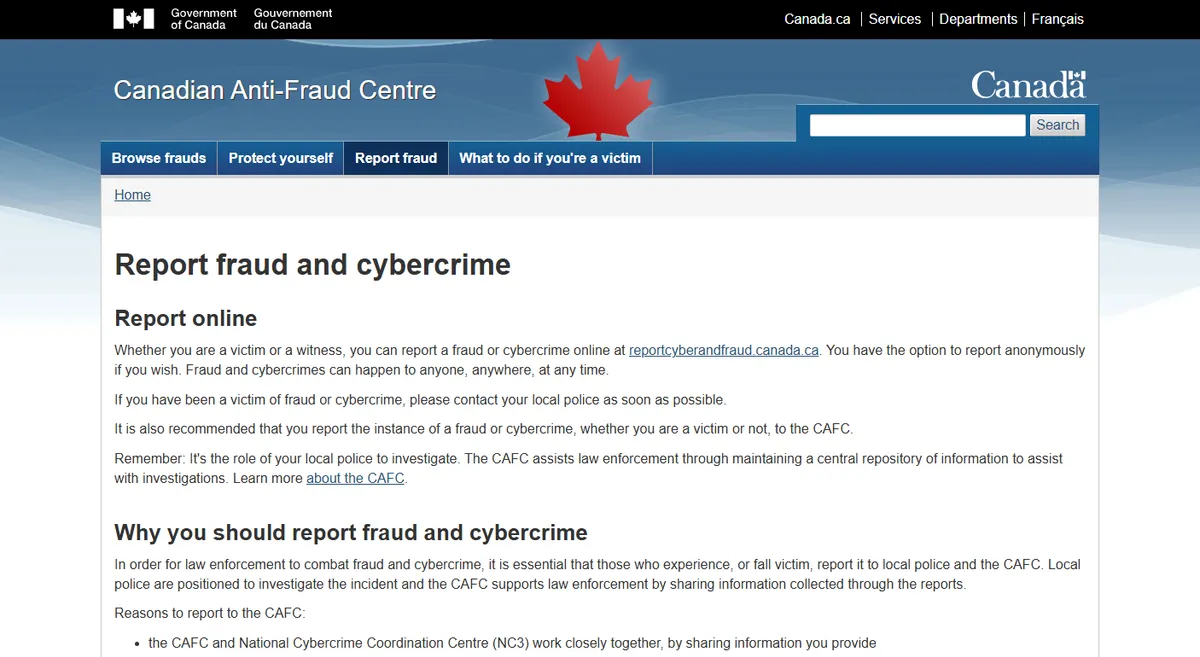
- Canada: local police, then the Canadian Anti-Fraud Centre (CAFC) online system at reportcyberandfraud.canada.ca, which accepts anonymous reports. You can also call toll-free on 1-888-495-8501, Monday to Friday, 10:00 to 16:45 Eastern time, closed on holidays. The CAFC page makes clear that investigation is handled by your local police.
Elsewhere, local police are the first stop. National reporting sites in the UK and other countries haven't been opened and checked for this page, so they're left out rather than risk sending you to a dead or outdated link.
When you fill in the form, paste in the material from the previous section in time order. Most forms have a payment-method field: pick cryptocurrency, then copy the receiving address and the transaction number across exactly. Type a long address out by hand and a single wrong character is enough to make it match nothing.
Your bank, and any ID you handed over
If the cash had just come out of your bank, or the scammer also had you make a transfer, ring your bank on the number on the back of your card or in its official app. Tell them you've just been scammed and ask them to watch for unusual activity. That won't bring back what went into the ATM, but it lets the bank assess the risk to your account and put protections in place.
Then think back over the call. Did you read out a licence or passport number, card details or a one-time code, or send a photo of an ID document? Bitcoin ATMs ask for ID and photos as part of normal verification (the tiers are explained in do you need ID in Australia), so separate what you gave a verified, legitimate operator from what went to the scammer or a suspicious machine. Uploading something on a machine doesn't by itself make it safe. If identity details did leave your hands, deal with that side too: in Australia, IDCARE; elsewhere, ask the police officer who took your report who to contact next.
Paid "recovery" offers that come looking for you
The FTC's guidance on refund and recovery scams warns that scammers buy and sell lists of people who've already been scammed — names, phone numbers, the type of scam, the amount lost. So after a loss, expect approaches like these:
- someone calling themselves a law firm, a "blockchain forensics company" or an "asset recovery specialist", saying they can trace the coins on-chain and get them back;
- someone claiming to be from law enforcement or from IC3, saying a suspect has been identified and you only need to pay a fee, a deposit or a tax for the funds to be released;
- "successful recovery" stories in social media comments or search ads, each with a contact number attached.
Every one of them gets round to the same thing: you pay first. IC3 states plainly on its homepage that it doesn't work with law firms, crypto services or any other non-law-enforcement body to recover funds, and that it won't contact you directly asking for information or money. Genuine police and regulators don't charge victims for "recovery".
When someone you didn't contact offers to get your money back, don't pay any "release fee" or "recovery fee", don't hand over a seed phrase, and don't install software they name. End the contact, check through official channels you found yourself, and add their details to your report. This warning is about strangers who approach you. A lawyer you sought out and hired yourself isn't a scammer simply because they charge for their work.
If the money won't come back: stop the second loss
With the steps above done, most of what can be done has been. What's left is keeping the damage from growing, which matters more than recovery:
- Stop every follow-up payment. "Release fees", "tax", "one last verification deposit" — all chapters of the same script. The first payment already happened. The second one you can still stop.
- Tell one family member or friend. Handling it alone, quietly, is exactly the state the people buying victim lists find easiest to work on. One more person in the loop means one more opinion the next time the phone rings.
- Let unknown numbers go to voicemail, or answer without discussing money. A real organisation will leave a message or write to you, and you can call back on a number you looked up.
- Report the machine's location and operator along with everything else. It won't do much for your own loss, but it goes into the pooled data.
An FTC data spotlight from September 2024 put reported losses to scams at bitcoin ATMs in the first half of 2024 at more than US$65 million, with a median reported loss of US$10,000. People aged 60 and over were more than three times as likely as younger adults to report losing money this way. Those figures are here to show the script is aimed at everyone; falling for it says nothing about how sharp you are. What matters now is finishing the steps above and making this the last time.
If you're still at the stage where someone is sending you to a machine and nothing has gone in yet, this page comes too late in the story. Read three questions before you pay instead, or go through the before you pay checklist.
Common questions
Does a bitcoin ATM operator have to refund me if I was scammed?
That depends on the law where you are and on whether the coins have already gone out. The FTC advises contacting the ATM operator immediately, telling them the transaction was fraudulent and asking for a reversal and refund. Once the network has confirmed the transaction, operators usually can't pull it back. Some US states have passed relevant laws; the National Conference of State Legislatures (NCSL) site tracks them by state.
Can police get my bitcoin back after I report it?
Nobody can guarantee it. Transactions on the blockchain can be traced, but identifying who actually controls a wallet and freezing assets across borders is slow and expensive. Reporting is still worth doing: it gives you a written basis when dealing with the operator and your bank, and it feeds the pooled data that links separate cases to the same group.
A stranger says they can recover my bitcoin if I pay a fee first. Should I trust them?
No. The FTC classes these approaches as refund and recovery scams aimed at people who have already lost money, and the FBI's IC3 states on its homepage that it doesn't work with law firms, crypto services or other non-law-enforcement bodies to recover funds, and won't contact you asking for information or money. If someone approaches you wanting an upfront recovery fee, a seed phrase or a software install, stop contact, verify independently and report them. That's different from a lawyer you chose and hired yourself.
This page covers what to do after a scam payment and how to limit further losses. Nothing here is legal advice, and no promise is made that money can be recovered. Steps and figures come from: FTC: what to do if you were scammed, FTC: refund and recovery scams, FTC data spotlight, September 2024, FBI IC3 homepage notice, Canadian Anti-Fraud Centre reporting page, Scamwatch: report a scam, ReportCyber.