BEFORE YOU PAY IN
Is This Bitcoin ATM Operator Registered? How to Check AUSTRAC, FinCEN and FINTRAC
A machine in a servo or a corner shop, with "Licensed" printed on the side, tells you nothing about whether the company behind it is known to a regulator. This page shows where to find the operator's name on the machine and the receipt, how to search the official registers in Australia, the United States and Canada, and why the UK regulator simply says not to use these machines at all.
Whether a bitcoin ATM is legitimate comes down to the company operating it, and in Australia, the US and Canada that company has to be registered with a financial regulator whose register anyone can search for free. Copy the operator's name off the screen or the receipt, look it up, and check two things: is it listed, and is the status current.
The UK works differently. The Financial Conduct Authority's warning page says none of the cryptoasset firms registered with it has been approved to offer crypto ATM services, so any machine operating in the UK is doing so illegally. If you're standing in front of one there, there's nothing to look up.
Working out which company runs the machine
Registers are searched by company name or registration number. The name splashed across the cabinet is usually a brand, while the register may hold the company's legal name, and the two don't always match. Three places tend to give you the real one:
- The machine's own screens. The footer of the start screen, the terms page or an "About" screen usually names the operating company in full, sometimes with a registration number.
- The top and bottom of the receipt. Plenty of operators print the company name, a support number and regulatory details there. The labelled receipt diagram shows what each line means.
- The legal pages on the operator's website. Find the site yourself through a search engine, then open pages titled "Legal", "Licenses" or "Terms". The name and number listed there are the best thing to take to a register.
Don't ring the number or scan the QR code on a sticker to ask whether they're legit. Stickers can be pasted over; can a bitcoin ATM itself be fake has a section on exactly that trick. Verification means taking the company name to an official register, not asking the other party to vouch for themselves.
Australia: searching the AUSTRAC VASP register
AUSTRAC, the Australian Transaction Reports and Analysis Centre, has regulated virtual asset businesses since 2018. On 30 June 2026 it announced that its register of virtual asset service providers (VASPs) had been made public, and it was plain about the purpose: so people can check whether a provider is registered with AUSTRAC before using its services. Exchanging virtual assets for money, and the reverse, is one of the services that requires registration — which is precisely what a bitcoin ATM does. The register is linked from the end of that announcement. The same page notes that AUSTRAC can suspend, cancel or refuse to renew a registration when a business poses an unacceptable risk of money laundering or other serious crime.
That power gets used. On 10 August 2026 AUSTRAC announced it had suspended the registration of ATM operator Cryptolink for three months from Sunday 9 August, taking all 96 of its machines out of service. The stated reasons: the company had failed to submit threshold transaction reports and had not responded to AUSTRAC's request for information. The practical lesson is that a clean result from last year proves little now. The check that counts is the one you run on the day you're at the machine.
Australian machines also come with their own cash limits, covered in bitcoin ATM limits in Australia, and ID rules, covered in do you need ID to use a bitcoin ATM.
United States: FinCEN registration and state licences
The Financial Crimes Enforcement Network (FinCEN), part of the US Treasury, set this out in its 2019 guidance on convertible virtual currency: anyone who owns and operates a crypto kiosk that takes cash and sends out coins, or the other way round, is a money transmitter and has to meet FinCEN's rules for that kind of business, including registering as a money services business (MSB).
The lookup is FinCEN's MSB Registrant Search: choose a state, then search by company name. An entry lists the legal name, any "doing business as" name (the brand you'd see on the machine), the address, the types of business and the states it operates in.
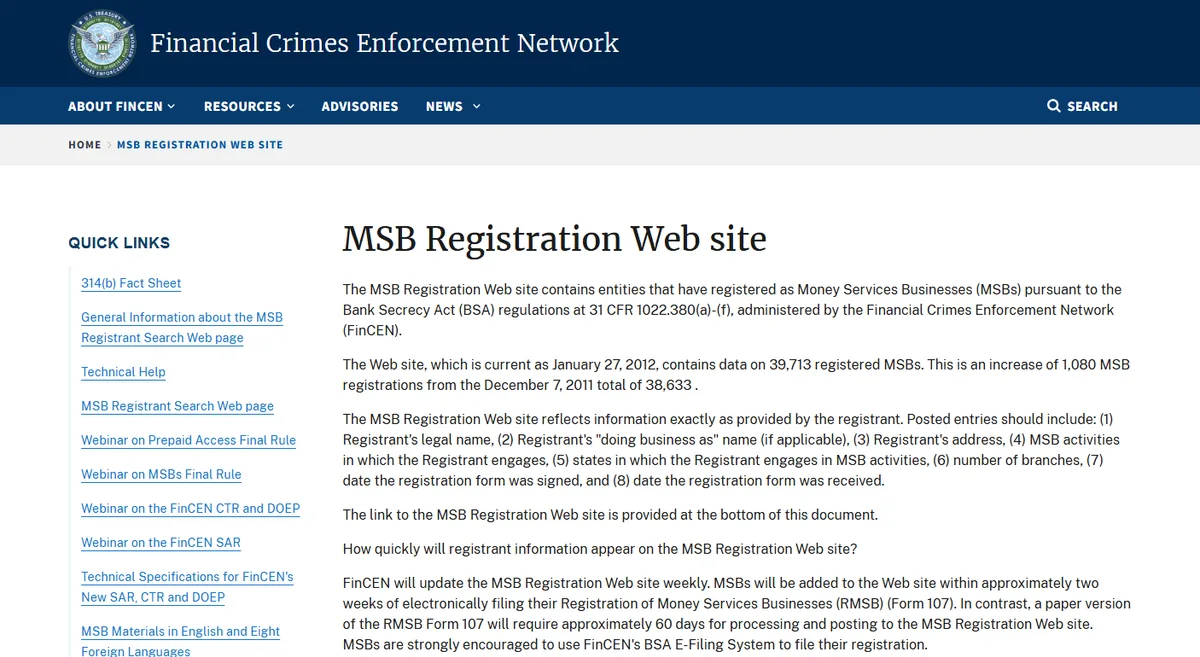
Read further down that same page before you take a listing as reassurance. The information is supplied by the registrants themselves, FinCEN does not verify it, and appearing on the site doesn't amount to a recommendation, certification of legitimacy or endorsement by any government agency. Registrations must also be renewed every two years, and lapsed ones are cleared out once a year. A hit at FinCEN only tells you the company has signed up at federal level.
The second layer is the state. Money transmission may need a separate licence in each state. State regulators that take part in the NMLS system publish licence details through one public lookup, NMLS Consumer Access, searchable by company name, NMLS ID or state licence number. Its own explanation carries two caveats: not every state puts every licence type into the system, and the entries are again self-reported by the licensee. If nothing comes up, try the financial regulator's website for the state the machine is in before drawing a conclusion.
Canada: the four statuses on the FINTRAC registry
The Financial Transactions and Reports Analysis Centre of Canada (FINTRAC) requires money services businesses to register before they start operating, and that includes foreign firms serving customers in Canada. The Money Services Business Registry sits on FINTRAC's own site; every field is searchable and the whole list can be downloaded.
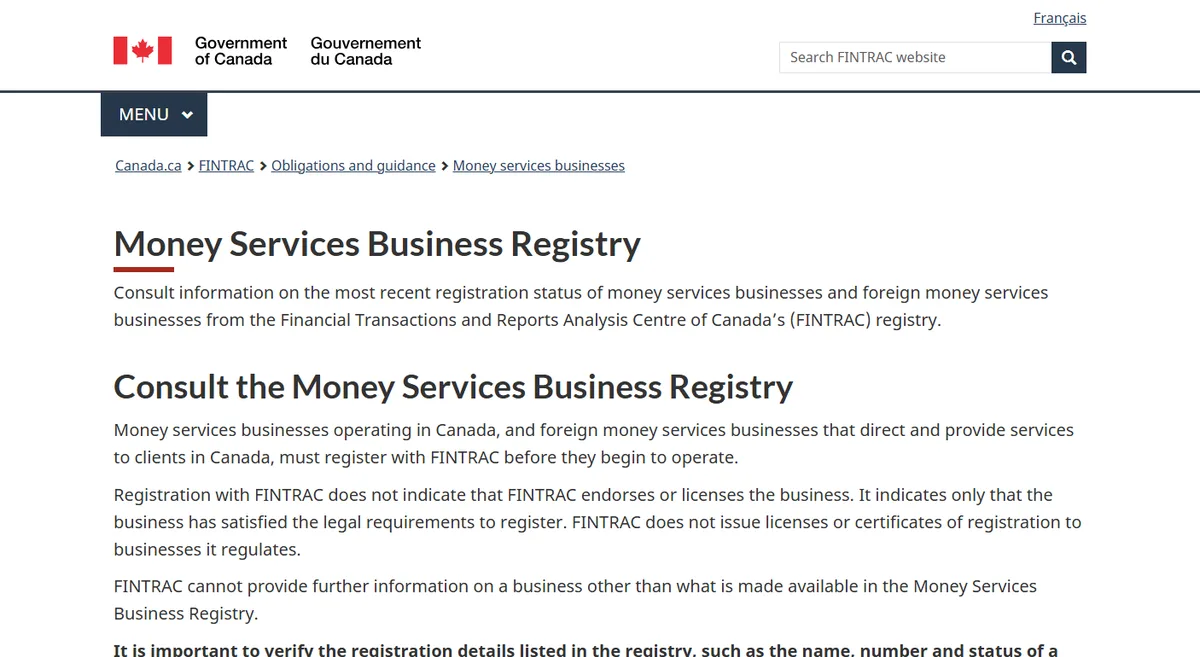
Once you've found the entry, the column that matters is "MSB Registration Status". FINTRAC uses four:
- Registered: currently on the registry. Businesses that have applied to renew and are still being processed show this too.
- Expired: the two-year registration ran out without being renewed.
- Ceased: the business told FINTRAC it no longer provides these services.
- Revoked: FINTRAC cancelled it, for reasons such as not answering FINTRAC's questions, not cooperating, or being found ineligible to register.
Any of the last three means the company shouldn't be running this business in Canada right now. The page also asks you to match the name, registration number and status together, and says the list is refreshed monthly, so a change in the past month may not show yet. Like FinCEN, FINTRAC is explicit that registration only means the business has met the legal requirement to register. It doesn't issue licences and doesn't endorse anyone.
United Kingdom: no operator is approved
The FCA first published its warning on 11 March 2022. The page was last updated on 6 February 2026, with the change log noting a system update and no change to the content. Three points in it matter here: crypto ATMs offering exchange services in the UK must be registered with the FCA and follow money laundering rules; none of the registered cryptoasset firms has been approved to offer crypto ATM services; and so any such machine operating in the UK is doing so illegally and consumers shouldn't use it.
If someone has told you to feed cash into a bitcoin ATM in the UK, the bigger problem is the person giving the instruction, not the machine. Start with three questions before you pay.
What your search result does and doesn't tell you
No match, or a status of expired, ceased, revoked or suspended: walk away from the machine. A name that doesn't match may just be a brand name versus a legal name, so go back to the first section and try again. If several spellings still turn up nothing, treat it as unlisted.
Listed, with a current status: the company is known to a regulator, carries anti-money-laundering obligations, and is a named party you can complain about or point to in a police report if something goes wrong. It says nothing about whether the machine's price is fair. Spread and fees are a separate question, worked through in what bitcoin ATMs really cost; the spread checker lets you run the numbers on the spot.
Nor does it make the person who sent you there trustworthy. Scammers favour these machines because they take cash and can send coins quickly; why scammers send you to a bitcoin ATM takes that apart. Once a bitcoin transaction is confirmed, you cannot cancel it yourself. If the operator has not sent the coins yet, it may still be able to hold the order: contact it immediately and follow the steps for after you've paid. A perfectly compliant machine can still deliver your money straight to a scammer's address.
Countries other than these four haven't been checked for this page. The approach carries over, though: look on your national financial regulator's website for a public list of virtual asset or money services businesses. If no such list exists, the machine can't be verified, and that should weigh on your decision.
Common questions
The bitcoin ATM says "Licensed and Regulated". Do I still need to check?
Yes. Anyone can print those words on a sticker, and stickers can be covered by someone else's. Verification means an official register: AUSTRAC's VASP register in Australia, FinCEN's MSB Registrant Search and NMLS Consumer Access in the US, and FINTRAC's Money Services Business Registry in Canada.
If the operator is on the register, can I still be scammed?
Yes. FinCEN and FINTRAC both state on their registry pages that registration doesn't mean government endorsement. A current registration means the company is under anti-money-laundering supervision and there's a clear party to complain to. If someone is directing you to send them money through a machine, that's a classic scam sign whoever owns the machine.
Is it legal to use a bitcoin ATM in the UK?
According to the FCA's warning, no operator is approved. The FCA says none of the cryptoasset firms registered with it has been approved to offer crypto ATM services, so any such machine operating in the UK is doing so illegally, and consumers shouldn't use them.
Registration details change. The register descriptions on this page were checked against the official pages in October 2026. Sources: FinCEN 2019 guidance on convertible virtual currency (FIN-2019-G001), FinCEN MSB registration explainer, NMLS Consumer Access, FINTRAC Money Services Business Registry, AUSTRAC: VASP register goes public (30 June 2026), AUSTRAC: Cryptolink registration suspended (10 August 2026), FCA: warning about illegal crypto ATMs in the UK.