CHECK THE DESTINATION
Wrong Address or QR Code at a Bitcoin ATM? What to Do Next
A mistyped address, an old wallet, an exchange deposit and somebody else’s QR code can all look like “the wrong address”. Start with the transaction’s status and network, then find out who controls the destination. That tells you whom to contact and what recovery might involve.
The address on your bitcoin ATM receipt is not the one you meant to use. Contact the operator immediately to find out whether it has sent the coins. If it has not broadcast the transaction, ask whether it can stop the order. If the transaction is unconfirmed, ask whether the sender can still act; there is no guarantee. Once it is confirmed, you cannot cancel it yourself or ask the operator to rewrite the blockchain.
Then work out who controls the receiving address. Another wallet of yours, an exchange deposit address and a stranger’s QR code need different responses. Use the transaction ID, or txid, to check the destination and amount on an explorer for the actual asset and network. A receipt’s order number is not necessarily a txid. No result on an explorer does not prove the coins have not been sent.
The ATM says “Invalid address”: has it sent anything?
An address has an error check built into it. That can reject a typing mistake, but it cannot tell the machine whether a valid address belongs to you. A perfectly readable QR code can still send the money to the wrong person.
For a bc1q address, BIP173’s Bech32 specification guarantees detection of up to 4 substituted characters when the length stays the same. It gives a random failure probability below one in a billion for more substitutions. That is not a guarantee for every insertion or deletion. bc1p addresses use Bech32m, defined in BIP350; legacy addresses beginning with 1 or 3 use a 4-byte checksum.
If the screen says “Invalid address” before you have inserted cash, check the selected coin against your wallet’s receiving screen, including the network. The machine may also reject an address type it does not support. Open the receive screen in your own wallet again. Do not switch to a code sent by someone offering to help.
Already put cash in? An error message does not tell you whether the cash was recorded or the coins were sent. Stop adding notes. Record the error and machine number, then ask the operator to check the order using the details in the contact checklist below.
You scanned a different wallet that you still control
Suppose you have two wallets on your phone and scanned the receiving code from the other one. Or you used an old address from an account you no longer open. If the address is yours and you can still spend from it, the problem may be finding the right account rather than recovering a transfer.
Compare the receipt’s destination with your wallets’ receive screens and address histories. Check the whole address. Once you find the matching account, check the transaction’s confirmations; the guide to ATM payments that have not arrived explains that wait.
Deleting a wallet app is different from losing every means of accessing the wallet. Check the original device and any existing backup before doing anything else. If you need to restore it, use that wallet’s official instructions. The recovery words, any extra passphrase, account path and address type must match; a different app may not display the same account automatically.
Without a usable device or private-key backup, neither the wallet company nor the ATM operator can reconstruct your keys. Never send recovery words to support, and do not type a hardware wallet’s backup into unfamiliar software to make a missing balance appear. An unsolicited offer of paid recovery is another reason to stop.
You sent the ATM purchase to an exchange, but it is not credited
First compare what the ATM actually sent with the exchange’s deposit instructions: asset, network, deposit availability, minimum amount and required confirmations. For a Bitcoin mainnet payment, the receiving page must accept BTC on the Bitcoin network. A valid-looking address is not enough. The operator may also require a wallet you control: CoinFlip’s US-site terms include that condition.
If the payment meets the exchange’s conditions but remains uncredited, open its official missing-deposit help. Binance’s self-service recovery guide requires an eligible, confirmed deposit into your own account; it does not handle an application for another user’s deposit. Start with the TxID/TxHash. Review any details filled in automatically, or supply the missing fields:
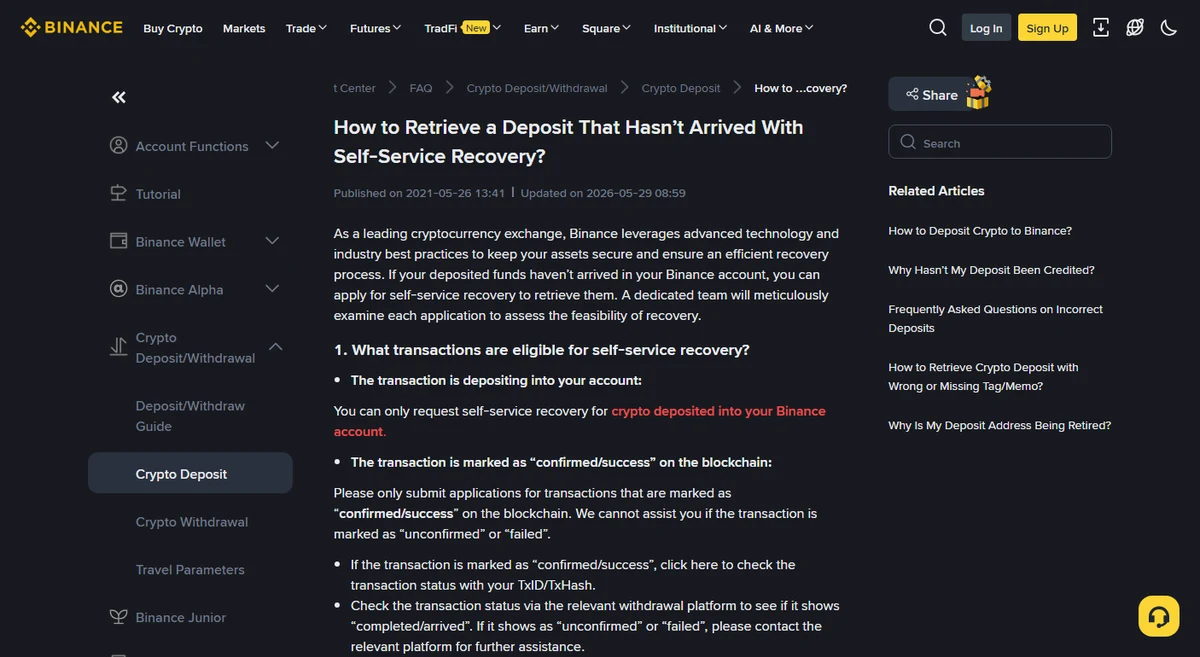
- The full coin ticker, such as BTC.
- The network and destination address shown on the blockchain.
- The actual deposited amount, with no separators; the amount field supports up to 8 decimal places.
The receipt is a starting point, and the operator can supply missing transaction details. See which receipt lines to keep. Using a friend’s deposit address does not make that exchange account yours. Recovery is not guaranteed; other exchanges have their own procedures.
You selected LTC, BCH or ETH instead of bitcoin
A “bitcoin ATM” may sell more than bitcoin. For example, Athena Bitcoin’s ATM terms filed with the SEC in 2022 named BTC, Litecoin, Bitcoin Cash and Ethereum. That is a historical example, not a current list of coins available at your machine. Selecting a different asset at the start changes what the machine sends.
Address formats do not always keep those assets apart. Ethereum addresses differ from Bitcoin addresses, but Litecoin has a legacy format beginning with 3 that overlaps with Bitcoin’s; see Litecoin Core’s mainnet address parameters. Bitcoin Cash, which split from Bitcoin in 2017, also used legacy addresses beginning with 1. The same address text can be valid on different chains.
If BCH was sent to that address on the Bitcoin Cash chain, a Bitcoin balance screen will not show it as BTC. Confirm the actual chain and transaction before concluding the funds are gone—or that they are recoverable.
- You control the wallet: follow its official wrong-asset recovery instructions for the particular address type and direction of transfer. Exodus documents BTC sent to a legacy BCH address, for example. That procedure cannot be assumed to work in reverse or in every wallet. Spending conditions and software support matter as well as possession of a private key. Do not hand over your recovery words.
- An exchange controls the address: ask that exchange whether it supports recovery of the actual asset and network. State what was sent, not what you intended to buy. Its support team must assess feasibility and any fee.
You scanned someone else’s code or a sticker on the machine
Scanning somebody else’s receiving code directs the payment to their address. The operator may have delivered exactly what its screen showed, even though that was not where you intended the money to go.
CoinFlip’s US-site terms, effective 30 September 2026, put address checking on the customer and disclaim losses from incorrect details. They provide transaction-fee refunds for reported, verified scams, with full refunds where law requires. Claims generally have a 90-calendar-day deadline, subject to legal exceptions. These are that operator’s terms, not an Australian refund rule; ask the operator at your machine which terms and local rights apply.
Athena’s 2022 filing likewise assigned responsibility for checking the screen’s address to the customer and treated sales as final once cash insertion began. Neither example means that an irreversible blockchain payment rules out a separate refund or compensation claim.
If a caller posing as support or police, or an online contact, told you to scan their code and pay, treat it as a suspected scam rather than just a typing mistake. What to do after an ATM scam covers contacting the operator, reporting the payment and avoiding recovery scams, including Australian reporting routes.
A receiving code stuck onto the cabinet may have been pasted over another label. If safe, photograph the machine and sticker and report them to the operator. The guide to tampered bitcoin ATMs explains that risk. Do not scan the sticker again to test it.
What to tell the bitcoin ATM operator
You do not need to finish diagnosing the mistake before calling. Find the operator’s number independently on its official website, rather than trusting a sticker. Have these details ready:
- A receipt photo showing the order number, transaction ID and receiving address. The receipt explainer helps distinguish them.
- The transaction date and approximate time.
- The shop name, street address and machine number.
- The address you intended to use and the actual destination, written separately.
Ask: “Has this order been broadcast? Which asset and network did you send, to which address, and for what amount? Can you provide the transaction ID?” If it has not been broadcast, ask whether the order can be held. If it is unconfirmed, ask what the sender can still do. A missing txid on your receipt is not evidence that the operator has not sent it.
Bitcoin Core’s explanation of replace-by-fee describes replacing eligible unconfirmed transactions. It does not give an ATM customer a cancel button, and the operator may be unable to act before confirmation. After confirmation, any refund is a separate payment, governed by the applicable policy and law.
If the destination was correct and the concern is the price you paid, that is a different dispute. See refunds after a bitcoin ATM purchase.
Questions about wrong-address ATM payments
Will a one-character mistake send my bitcoin to somebody else?
Address checks can catch typing errors; they cannot check ownership. For bc1q addresses, BIP173 guarantees detection of up to four character substitutions at a fixed length, not every insertion or deletion. An ATM error is not proof that no coins were sent. Ask the operator to check the order.
Can the ATM operator refund a payment sent to a scammer?
A confirmed transfer cannot simply be cancelled, but refund rights are a separate question. Ask the operator to investigate and check the rules that apply where you used the machine. The US-site CoinFlip policy discussed above is not a universal refund policy.
The transaction is confirmed but my exchange balance is empty. What now?
Match the transaction ID, asset, network and receiving address, then check deposit availability, the minimum deposit and required confirmations. If those conditions are met, use the exchange’s official missing-deposit procedure. A recovery application is not a promise that the funds can be recovered.
Technical references: BIP173, BIP350 and Base58Check encoding. Operator and recovery sources are linked beside the relevant advice; the public pages were checked on 24 October 2026. Athena’s SEC filing is a historical document.